
The Pika Art AI video generator on Pollo AI highlights how modern AI video platforms are evolving toward centralized, browser-based creative workflows. Instead of forcing creators to rely on separate generation tools, Pollo AI integrates multiple AI video models into one production environment, allowing users to experiment with different visual engines more efficiently.
Originally developed by Pika Labs, Pika AI became widely recognized for its stylized video outputs, creative animation effects, and simplified generation process. Since its launch in 2023 by two Ph.D. students, the company has gained substantial attention within the AI video industry and reportedly raised $135 million in funding by mid-2024. Today, the Pika Art AI video generator is commonly used for short-form content, animated storytelling, social media visuals, and experimental AI video production.
What is Pika Art AI Video Generator on Pollo AI?
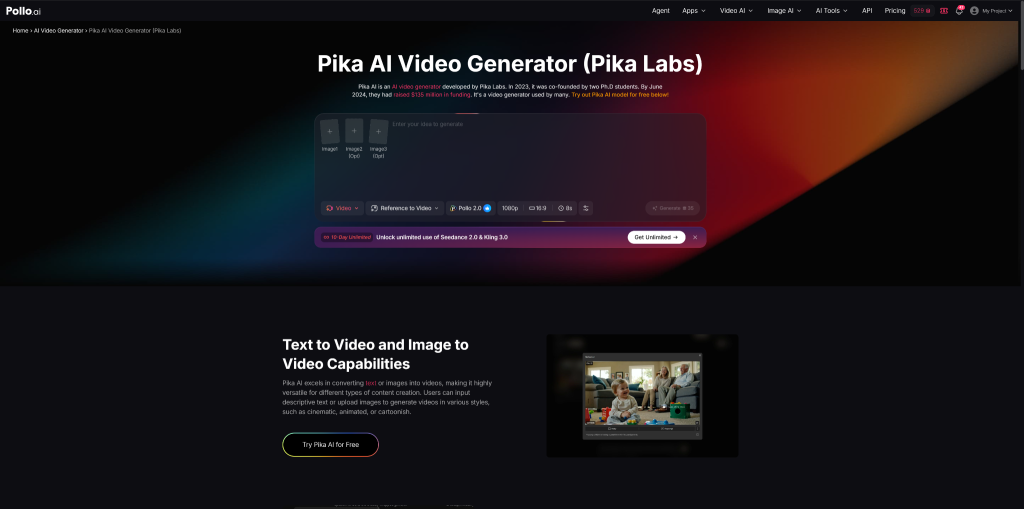
Pika Art AI Video Generator is an AI-powered video generation model developed by Pika Labs that transforms text prompts or uploaded images into short animated videos. The system is designed to simplify content creation by allowing users to generate engaging visual clips without traditional editing software or advanced animation skills.
Inside Pollo AI, the Pika Art AI video generator operates as part of a larger multi-model AI video ecosystem. This integration allows creators to access Pika AI alongside other video generation systems within the same browser-based workspace. Instead of switching between disconnected platforms, users can compare styles, motion behavior, and rendering outputs more conveniently.
The Pika Art AI video generator supports several visual styles, including cinematic, animated, and cartoon-inspired formats. This flexibility makes it useful for creators producing marketing videos, storytelling content, educational explainers, meme-style clips, and lightweight promotional assets.
Because the workflow prioritizes simplicity and accessibility, even users with limited editing experience can begin creating AI-generated videos quickly.
Why Pollo AI Integrated Pika Art AI Model?
The decision to integrate the Pika Art AI video generator into Pollo AI reflects increasing demand for centralized AI creative workflows and modern video meme maker capabilities that allow creators to quickly produce engaging, shareable content. Many creators no longer rely on a single AI model for every project. Instead, they prefer platforms that provide access to multiple generation engines in one interface.
Pika AI contributes a distinctive creative style to the Pollo AI ecosystem. Compared to some AI video systems that focus heavily on realism, Pika AI often emphasizes stylized animation, exaggerated motion, and visually playful effects. This makes it particularly appealing for short-form social media content, experimental creative projects, and fast-turnaround video meme maker workflows designed for viral distribution.
Another reason for the integration is accessibility. Pollo AI positions itself as a browser-based production environment where users can generate videos without managing complicated local software installations or GPU-heavy rendering pipelines. By adding the Pika Art AI video generator, the platform expands its range of creative options while maintaining a relatively simple user experience.
The integration also complements Pollo AI’s broader effects ecosystem. While Pika AI already includes its own Pikaffects system, Pollo AI additionally offers an expanded video effect library that includes AI inflation effects, explosion effects, squish-style animations, AI kissing sequences, AI hug effects, and other interactive transformations designed for entertaining social media videos.
Key Features of Pika Art AI Video Generator on Pollo AI
Text-to-Video and Image-to-Video Capabilities
One of the strongest aspects of the Pika Art AI video generator is its ability to convert both text prompts and static images into animated video clips. Users can either describe a scene using natural language or upload reference images to guide the visual generation process.
This flexibility makes the tool suitable for a wide variety of content creation scenarios. Users can generate cinematic scenes, cartoon-style animations, fantasy visuals, social media ads, or stylized storytelling clips depending on the prompt structure and selected visual direction.
Because the generation process is automated, creators can produce multiple concept variations far more quickly than with traditional editing software.
Pika Effects (Pikaffects)
One of the most recognizable features of the Pika Art AI video generator is its Pikaffects system. These effects allow users to manipulate objects inside generated videos using stylized visual transformations.
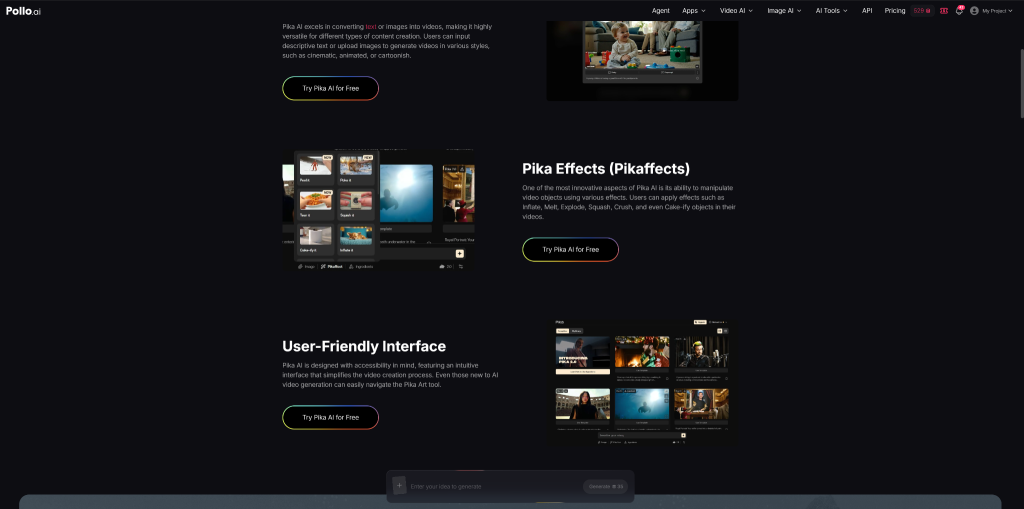
Available Pikaffects inside the Pika Art AI video generator include creative transformations such as Inflate, Melt, Explode, Squash, Crush, and Cake-ify, allowing users to manipulate objects in visually exaggerated and entertaining ways for more engaging short-form video content.
These effects are designed to make short-form videos more visually dynamic and entertaining. Rather than focusing purely on realism, Pikaffects encourage exaggerated visual storytelling and experimental animation styles that perform well on social media platforms.
For creators producing meme content, entertainment clips, or viral-style videos, these effects add another layer of creative flexibility.
User-Friendly Interface
Another advantage of the Pika Art AI video generator on Pollo AI is accessibility. The interface is intentionally simplified so that users with minimal editing experience can still generate AI videos effectively.
Traditional video production often requires editing timelines, motion graphics software, rendering workflows, and advanced technical knowledge. In contrast, Pika AI reduces much of this complexity through prompt-based generation.
Inside Pollo AI, the browser-based interface further streamlines the process by keeping model selection, prompt input, and video rendering inside a centralized workspace.
How Pika Art AI Video Generator Works Inside Pollo AI?
The workflow for using the Pika Art AI video generator on Pollo AI is relatively straightforward.
Step 1: Select the Pika AI Model
Users begin by entering the Pollo AI image-to-video or video generation workspace and selecting the Pika AI model from the available generation engines.
Because Pollo AI integrates multiple AI systems, creators can compare Pika AI outputs against other video models depending on the desired visual style.
Step 2: Upload an Image or Enter a Prompt
After selecting the model, users can upload an image reference or type a detailed text prompt describing the desired scene, motion, camera perspective, environment, and visual style.
More detailed prompts generally produce more coherent and visually structured outputs.
Step 3: Start Video Generation
Once the settings are configured, users simply click the Create button and allow the Pika Art AI video generator to process the request.
The AI automatically generates animated video clips based on the provided instructions. Because the workflow is browser-based, users do not need advanced local hardware to begin experimenting with AI-generated video content.
Performance
The Pika Art AI video generator performs particularly well in stylized short-form video generation. Its outputs often emphasize creative animation, fluid transitions, and visually expressive motion rather than strict cinematic realism.
For social media creators, this can be an advantage. Many platforms prioritize eye-catching visual experimentation over perfectly realistic rendering. The fast generation speed also allows creators to test multiple ideas within short publishing cycles.
The text-to-video and image-to-video systems are generally responsive and accessible for beginners. However, like many current-generation AI video models, the system may occasionally struggle with long-sequence continuity, detailed character consistency, or highly complex scene choreography.
The overall experience is strongest when used for:
- Short-form social videos
- Animated concept clips
- Meme-style content
- Creative marketing assets
- Experimental storytelling
- Stylized motion graphics
Practical Use Cases
The Pika Art AI video generator on Pollo AI supports a broad range of creative applications.
Social Media Content Creation
Creators can rapidly generate short videos optimized for TikTok, Instagram Reels, and YouTube Shorts. Stylized effects and fast rendering workflows make the system suitable for high-volume publishing strategies.
Marketing and Advertising
Brands and marketers can use the platform to create lightweight promotional visuals, animated ads, or product storytelling clips without requiring full-scale video production teams.
Educational Content
Teachers, educators, and explainer-video creators can generate animated visual sequences that simplify storytelling and concept visualization.
Experimental Creative Projects
Digital artists and experimental creators often use the Pika Art AI video generator for surreal visuals, fantasy scenes, and artistic motion experiments that would be time-consuming to produce manually.
Is it Worth it?
The Pika Art AI video generator on Pollo AI is most valuable for users seeking fast, accessible, and creatively flexible AI video production. Its strengths lie in stylized animation, browser-based simplicity, and rapid experimentation rather than traditional cinematic precision.
For beginners, the platform lowers the technical barrier to AI video creation significantly. For experienced creators, it offers a faster ideation workflow and access to creative effects like Pikaffects.
Although the tool is not entirely free, users can typically test the system through limited free access before upgrading to paid plans for additional generation credits and advanced features.
Overall, the Pika Art AI video generator on Pollo AI works well for creators focused on short-form content, visual experimentation, and fast AI-assisted production workflows. While professional filmmakers may still require traditional editing pipelines for highly controlled cinematic projects, the platform remains a practical option for modern social media video creation and lightweight digital storytelling.