
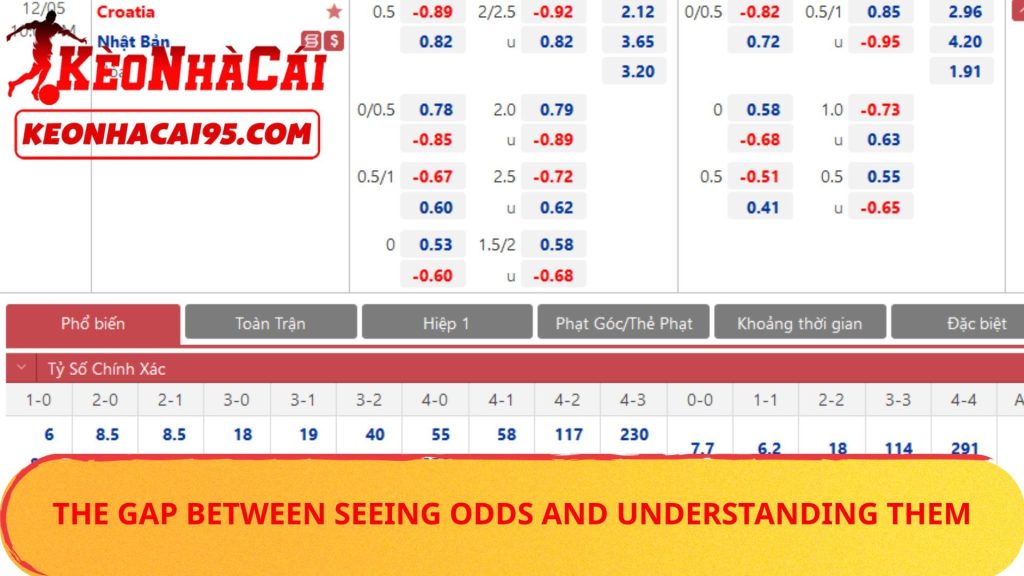
Most people glance at odds and move on. They see a number, form a quick opinion, and leave without asking what that number actually reflects. Kèo Nhà Cái approaches this differently. The platform at keonhacai95.com is structured around detailed odds analysis — layering handicap data, line movement, and cross-market comparisons into a format that makes the information genuinely useful, not just visible.
This piece breaks down how that analysis works in practice, and what you can actually learn from it.
The Gap Between Seeing Odds and Understanding Them
There’s a version of odds-reading that most people do: you check the Asian handicap, note which side is favoured, and move on. That works at a surface level. But it misses a significant portion of what the data is communicating.
What a Handicap Line Is Actually Measuring
A handicap line isn’t just a prediction of match outcome. It’s a consensus — a number that reflects the combined assessment of oddsmakers, adjusted by the volume and direction of incoming bets. When a line opens at -0.75 for the home side and moves to -0.5 by kickoff, that shift tells a story. Maybe sharp money came in on the away team. Maybe injury news quietly circulated. Maybe the public was leaning too heavily in one direction and the market corrected.
Reading that story requires more than a snapshot. It requires context — which is exactly what a detailed analysis platform is designed to provide.
Why Single-Market Views Fall Short
Looking at 1 bookmaker’s odds in isolation is like reading a weather forecast from a single station. It gives you something, but it doesn’t give you confidence. Cross-market analysis — comparing how different bookmakers price the same fixture — reveals where consensus is strong and where genuine disagreement exists. When 4 bookmakers agree on a line and 1 outlier sits 0.25 higher, that gap is worth examining.
How Kèo Nhà Cái Structures Its Analysis Tools
The platform organises odds data in a way that supports systematic comparison rather than casual browsing. Kèo Nhà Cái breaks this down across 3 main bet types, each with its own analysis layer. Here’s what that looks like in practice.
Asian Handicap Analysis
Asian handicap (AH) remains the format most relevant to Southeast Asian football markets. The platform tracks not just the current line but its history from opening to close. For a match with significant pre-game attention, you might see 6 or 7 line adjustments over a 48-hour period. Each adjustment is a data point.
The key insight: lines that move early and then stabilise tend to reflect genuine information. Lines that drift gradually without a clear trigger are often just responding to public volume — less meaningful from an analytical standpoint.
Over/Under Depth
Total goals markets (tài xỉu) get their own analysis layer. A match priced at 2.5 goals carries different implications depending on whether it opened at 3 and compressed downward, or opened at 2.25 and rose. Same current line, very different market narrative.
Kèo Nhà Cái surfaces this movement data alongside the current figure, so you’re not just seeing where the market is — you’re seeing how it got there.
Corner and Card Markets
Beyond the main match result, the platform also covers corner counts and card totals for major fixtures. These secondary markets are worth tracking because they often move independently of goals-related lines. A referee known for leniency, or a match with high expected tempo, can create interesting divergences between what the main market implies and what ancillary lines suggest.
Practical Analysis — Reading a Match Before Kickoff

To make this concrete, here’s how a structured pre-match analysis session might look using the platform’s data.
Start with the Asian handicap. Note the opening line, the current line, and the direction of movement. If the line has tightened — say, from -1 to -0.75 — the favourite is being backed less confidently than the market initially expected. That’s relevant.
Cross-reference with the over/under. A compressing total (moving down) often suggests the match is trending defensively. A rising total alongside a tightening handicap can indicate a shift in how both teams are being assessed.
Then check the European odds (1X2). The implied probability from 1X2 odds sometimes diverges from what the Asian handicap implies — a discrepancy that occasionally points to a market inefficiency worth noting.
A useful reference point: match data and line history for ongoing fixtures can be verified directly at https://keonhacai95.com/, where the analysis layers are updated throughout the day.
Common Analytical Errors and How to Avoid Them
Treating Movement as Always Meaningful
Not every line shift carries signal. Late-closing movements driven by recreational bettors add noise rather than information. Learning to distinguish early sharp movement from late public drift is one of the more useful skills in odds analysis — and it takes time to develop.
Over-Indexing on Familiar Teams
Familiarity creates bias. When you follow a club closely, you tend to overestimate how much the broader market knows what you know. In practice, major bookmakers have highly efficient models for top-tier competitions. The edge, if any exists, tends to appear in lower leagues, early-season fixtures, or markets with lower liquidity.
Ignoring the Juice
The margin built into odds (the “juice” or vigorish) affects the implied probability calculation. A line of -110 on both sides of a market implies a total probability above 100% — the excess is the bookmaker’s margin. Comparing markets without accounting for margin can lead to misleading conclusions about where value might sit.
Frequently Asked Questions
Does detailed odds analysis require professional experience?
Not necessarily. The fundamentals — reading line movement, comparing markets, distinguishing signal from noise — are learnable with consistent practice. What helps is having clean, organised data to work with, which is what a structured platform provides.
How many bookmakers does Kèo Nhà Cái aggregate?
The platform pulls from multiple major bookmakers operating in Asian markets, giving users a representative view of where consensus sits and where outlier pricing appears.
Is the analysis only relevant for major leagues?
The data coverage extends across leagues of varying profile. That said, analysis tends to be more straightforward for major competitions where market depth is higher and bookmaker models are more refined.
Conclusion
Odds are information. Whether that information is useful depends entirely on how you read it. Kèo Nhà Cái provides the structure to move beyond surface-level numbers — tracking line history, surfacing cross-market comparisons, and organising the kind of data that supports genuine pre-match analysis.
For anyone who engages with football odds as more than a casual activity, the difference between a raw feed and a properly structured analysis platform is significant. The numbers themselves are widely available. The context that makes them meaningful is harder to find — and that’s where a detailed odds platform earns its place.