
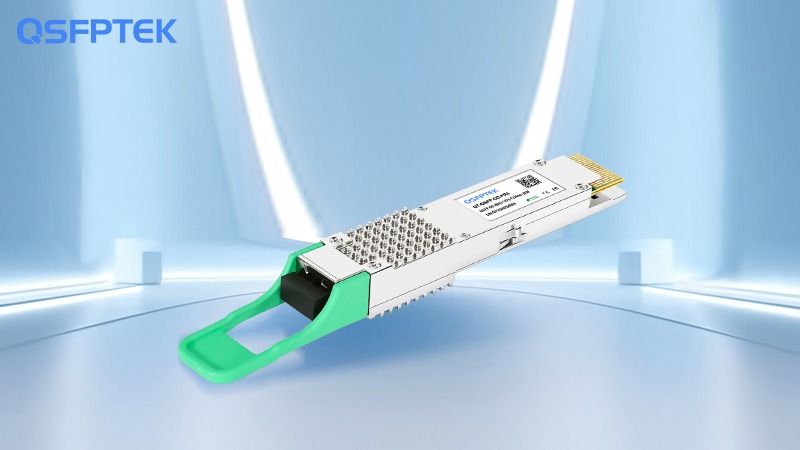
In the pursuit of higher network density and efficiency, 400G optics have become central to modern data center architectures. Arista Networks offers two part numbers for its 400GBASE-FR4 optical transceiver: QDD-400G-FR4 and OSFP-400G-FR4. While their descriptions are functionally identical—both support 400Gb/s over 2km of duplex single-mode fiber using four 100G PAM-4 optical channels—the critical difference lies not in performance but in physical design. This article explores the key distinctions between these two form factors to guide your infrastructure choices.
Key Specifications at a Glance
The following table summarizes the primary similarities and differences between the two modules based on the provided documentation:
| Feature | QDD-400G-FR4 (QSFP-DD Form) | OSFP-400G-FR4 (OSFP Form) | Commonality |
| Form Factor | QSFP-DD (Double Density) | OSFP (Octal Small Form-factor Pluggable) | Hot-pluggable |
| Arista Part Number | QDD-400G-FR4 | OSFP-400G-FR4 | Officially listed Arista transceivers |
| Key Physical Distinction | Based on QSFP, adds a second row of contacts for 8 electrical lanes. | Slightly larger, designed with 8 electrical lanes from the outset. | Physically incompatible; cannot be swapped. |
| Max Power Consumption | lower (≤ 9W) | higher (≤ 12W) | – |
| Thermal Design | Standard QSFP-DD housing. | Often features a finned top for enhanced airflow and cooling in high-density switches. | – |
| Electrical Interface | 8 electrical lanes at 50Gb/s each | 8 electrical lanes at 50Gb/s each | Total electrical bandwidth of 400Gb/s. |
| Optical Standard | 400GBASE-FR4 | 400GBASE-FR4 | Identical. |
| Reach & Fiber | Up to 2km over duplex Single-Mode Fiber (SMF) | Up to 2km over duplex Single-Mode Fiber (SMF) | Uses a duplex LC connector. |
| Optical Technology | 4 wavelengths (lanes) multiplexed onto one TX and one RX fiber. | 4 wavelengths (lanes) multiplexed onto one TX and one RX fiber. | CWDM technology, PAM-4 modulation. |
| Primary Application | High-density 400G connectivity in QSFP-DD based switches. | High-density 400G connectivity in OSFP-based switches, often in air-cooled environments. | Data center interconnects, spine-leaf networks. |
Understanding the Core Difference between OSFP vs. QSFP-DD
The single most important difference is physical and electrical incompatibility.
As Arista’s FAQ states, “If you have an OSFP system, then OSFP optics and cables must be used. If you have a QSFP-DD system, then QSFP-DD optics and cables must be used.” Your choice is dictated entirely by the switch platform you are using. The good news is that at the optical level, they are fully interoperable; an OSFP-400G-FR4 module can seamlessly connect to a QDD-400G-FR4 module over a standard single-mode fiber link, provided both ends are configured for the same standard.
QSFP-DD (QDD-400G-FR4)
The QSFP-DD form factor is a backward-compatible evolution of the widely adopted QSFP. It retains the same frontal footprint but adds a second row of electrical contacts, doubling the number of high-speed lanes from four to eight. This design allows for potential backward compatibility with lower-rate QSFP optics in the same port (depending on switch support), offering flexibility in network upgrades. It is designed for very high port density.
OSFP (OSFP-400G-FR4)
OSFP was designed from the ground up for 400G and beyond. It is slightly wider and deeper than QSFP-DD. This larger size allows for enhanced thermal management, which is why many OSFP modules feature a “finned top” to dissipate heat more effectively in high-power applications. It is often favored in platforms where thermal performance is a critical design constraint.
Practical Implications for Your Network
- Switch Compatibility is Paramount: Always verify your switch’s supported form factor (OSFP or QSFP-DD) before purchasing transceivers. They are not interchangeable.
- Thermal and Power Considerations: In extremely dense, air-cooled deployments, the OSFP’s inherent thermal advantages might align with specific switch designs. Some vendors’ specs note a 1W difference in maximum power consumption (9W vs. 10W), which can scale in large deployments.
- Path to the Future: Both form factors are road-mapped for 800G. Your choice today may influence your upgrade path within a specific vendor’s hardware ecosystem.
- Third-Party Compatibility: Compatible modules from third-party manufacturers are available for both form factors. These can offer significant cost savings while maintaining full functionality, provided they are rigorously tested for interoperability with your specific switch model.
Conclusion
The decision between Arista’s QDD-400G-FR4 and OSFP-400G-FR4 is not about choosing a superior technical performer—both deliver identical 400GBASE-FR4 connectivity. The choice is strategic and ecosystem-dependent. It hinges on your existing or planned switch infrastructure:
- Choose QDD-400G-FR4 (QSFP-DD) for switches built on the QSFP-DD standard, especially if backward compatibility with QSFP optics or maximum front-panel port density is a priority.
- Choose OSFP-400G-FR4 for switches designed with OSFP ports, where the form factor’s dedicated design for high-speed optics and its robust thermal management are key advantages.
Understanding this fundamental distinction ensures you invest in the right physical component for your high-speed network, enabling optimal performance and a clear path for future scaling.